Monday, October 28, 2013

Sir Anthony Blunt on Leonardo and Michelangelo - Discussion 4

 
Sir Anthony Blunt wrote extensively on the artist methods of both Leonardo and Michelangelo. What his analysis boils down to is that Leonardo is a master artist concerned with scientific procedure and accurateness, where as Michelangelo was a master artist concerned with pure aesthetics, at times bending the truth to please the eye. 

Leonardo is described as meticulously astute to the scientific nature of perspective and anatomy. He used these sciences to lend accuracy and beauty to his artworks, and according to Blunt maintained that even the media of painting was more noble and scientific than that of his fellow Michelangelo's sculpture. Painting is able to utilize color, aerial perspective, and depict luminescence better than sculpture can. Leonardo also greatly emphasized drawing from life, due to his belief that if one were to draw from a previous sketch it will become more and more "unnatural and mannered." Copying the work of another painter could also lead to this horrible fate, in Leonardo's eyes. 

  
While Leonardo was most opposed to mannered nature in artworks, it was not a concept that Michelangelo was opposed to. He, like Leonardo, dissected bodies to gain an intimate knowledge of anatomy, but did not fret over tweaking the bodily composition to further please the eye. At times he fiddles with figures, mostly those of women, to gain ideal musculature. In subject manner Michelangelo most always utilized biblical figures, and explored his own faith through them. His process was also significant spiritually, since he felt that one did not carve a sculpture, they simply unveiled what God had left inside to be discovered. 

To compare the two artists it to compare two kinds of fruit. Both are of the most talented to have ever lived, but neither are concerned with the same methodology or purpose. On one hand there is Leonardo, concerned with all things academic and the scientific nature of painting; on the other is Michelangelo, concerned with the will of God, and how best to please him and fulfill his spiritual life.  

Sunday, October 13, 2013

Titian's Venus of Urbino - Discussion 4

                     Titian, Venus of Urbino, 1538.


Painted for duke of Camerino, Titian's Venus of Urbino is his iconic master piece. In the article by Rona Goffen, the composition, inspirational predecessors, and its sexual content is analyzed. To begin with, Titian of course sought out inspiration for the composition from one of its namesakes. the Venus Pudica, or the 'modest Venus'.
 
                                             Venus Pedica

It is highly emphasized that while this Venus is modest, and Titian has used it as an inspiration, his is not modest, but supporting herself with her arm rather than covering herself. Perhaps a more obvious source of inspiration was that of one his contemporaries, Giorgione's  Sleeping Venus. 
                 Giorgione, Sleeping Venus.

While Titian and Giorgione's Venus's are strikingly similar in posture and body type, there are two very important difference, which almost completely change the meaning and context of Titian's version. Giorgione has his Venus set in the outdoors, which is a typical and traditional setting for a classical subject. Generally if the woman is classicised, it is deemed ok for nudity to be present. However, it is noticed that Titian's Venus of Urbino is set indoors, on a tousled bed, with maid servants either retrieving of putting away some of her clothes. Goffen even points out that some of the furniture would have been recognizable to contemporaries as marriage furniture, signifying that she is indeed in a bedroom, which immediately sexualizes the context. The other major difference between Sleeping Venus and Venus of Urbino is eye contact. While Sleeping Venus obviously can not make eye contact, Venus of Urbino is looking directly and boldly into the viewer's eyes, in a relaxed sort of way. This implies that either the viewer is is being invited closer. This is highly unusual, generally classical Venus's avert their eyes and stare dreamily away, or in fact have them closed. The fact that Titian's Venus is making eye contact creates a much more intimate experience. 

Despite these bold choices, Goffen also wanted to convey that this would generally not have been considered as pornographic for the time, and was still high art. There were in fact a series of pornographic engravings in circulation, as well as books that followed those same lines. Compared to these explicit examples, Titian gives his Venus a presence other than objectifying her physically. She is a figure of beauty, with a personality, and a sense of sexuality- not over sexualization. 


Monday, September 30, 2013

Cultural Introduction to Renaissance Rome - Discussion 3

                             Old Saint Peter's Basilica 

It is quite easy for students studying Rome to forget that the city ever fell. There are so many rich events to be discussed in regards to this ancient city. From the founding myths of Romulus and Remus, to the brutality and extravagance of Emperors like Nero, the Colosseum, and the art produced in the Renaissance. It is so easy to glaze over the decay of classical Rome and concentrate on the exciting and enlightened ages around it. 

However, Ingrid D. Rowland's article "Cultural Introduction to Renaissance Rome" emphasizes the ruins to which the Papacy returned to from Avignon, France. Petrarch is quoted on what he saw during the period of Rome's decay after it had fallen to the Visigoths and Vandals,
    "Although when I first...went to Rome, almost nothing was left of that old Rome but an outline or an      image, and only the ruins bore witness to its bygone greatness, nonetheless, among these ashes            there were still some noble sparks; but now the ash is long extinguished and grown cold."
According to this quotation, Rome appeared to be without hope of ever being great again. It appears that about this, Petrarch was incorrect. When the Papacy returned to the land where Christianities many founding events took place, Rome was much the same as it had been described by Petrarch. The city was still in ruins, among which the residents had made seemingly temporary housing by comparison. However, with the clergy came people and businesses to serve it. As economics increased, so did the effort to rebuild and reclaim the glory of Rome. 

Much of this effort was in new construction, mostly churches. These of course were commission by popes, or occasionally by cardinals who were competing for the most impressive projects. It is obvious that the architects were inspired by the ancient Roman classicism around them, however their veneration did not prevent them from looting the ruins for materials to build with, such as the case of the Colosseum who's materials were taken and reused for the palazzi. 

Another significant portion of Rome's progress from the dark ages to renewal of glory was the opportunity of a humanist education. Although, as I discussed in my first posting, humanist educations were not as free and available to everyone as we commonly think today, it did allow for those who came from wealthy families (but with tarnished circumstances) to progress and create a name and wealth for themselves. The architect Alberti was the son of a Florentine banker, however he was illegitimate; his humanist education allowed him the ability to gain the wealth that he could never inherit from his father. Many other men who belonged to the humanist practice were eloquent and prided themselves on their oratory skills, as well as gaining knowledge from classical Roman texts. While they were often questioned by christian preachers on grounds of morality, the humanists argued that God's "method of creation" was reflected in these ancient Roman author's works. 

With this renewed emphasis the Vatican Library was established by Nicholas V, and was decorated with frescos by Fra Angelico. This illustrates quite well how popes would erect a building of significance and power, whether it be a library or church, and then proceed to commission art works for these new constructions. Leaving behind a large, beautiful, and frequently dominating monument for others to remember them by mimics the practices of classical Roman Emperors constructing baths, and other forms of entertainment as there legacy. 


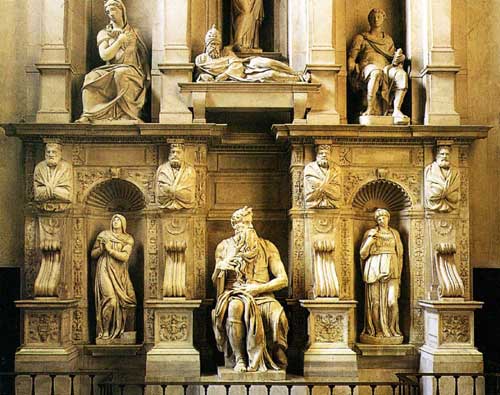
A great example of this is Saint Peter's Basilica. Pope Julius II, a fiery man who also had a great love for art and commissioned much of it, condemned and tore down the Old Saint Peter's Basilica (shown above). He commissioned Bramante to design and construct the replacement, which would be more grand, and would have two main roads leading straight to it. Within the new Saint Peter's Pope Julius planned on having his tomb constructed in the center, right above the resting place of Saint Peter. This was to be designed and decorated by Michelangelo, although it was never finished, the sculptures are quite stunning.   
 
Not long after Pope Julius II's death did the extravagant construction and commissions slow. While they were not torn down by later Pope's who disapproved of using one's power in such a way, there has yet been such a surge in monumental, classicized art. 


Monday, September 23, 2013

Leonardo da Vinci: Flights of Mind (185-215) - Discussion 2

Pages 185- 215 of Leonardo da Vinci: Flights of Mind focuses on Leonardo's initial move to Milan from Florence,  his paintings Virgin of the Rocks, and his early notebooks. When Leonardo first moved to Milan, approximately 180 miles by his calculations, the Sfoza were the ruling family. The Sfoza were considered to be militaristic, however they were major patrons of art. This is the family that Leonardo would surround himself with, receive a commission for a ceiling painting, and later sell the original Virgin of the Rocks to. 


Many of Leonardo's early sketches were of a military nature, which of course interested Ludovico Sfoza, who was also called "the Moor" due to his dark skin color. Ludovico was a regent and Duke, but held the majority of power in the Sfoza family, and was described as "ruthless, pragmatic, and intelligent". Even though there was interest shown in Leonardo's military inventions, they never were fully developed. While Ludovico never commissioned Leonardo to execute one of his military ideas, he did purchase the first version of Virgin of the Rocks, which was commissioned by a separate party called the Confraternity of the Immaculate Conception.

The Confraternity of the Immaculate Conception originally commissioned Virgin of the Rocks as a three paneled (triptych) altarpiece. There also were various guidelines to include angles other christian symbols. The first version produced is oddly devoid of these elements, and is of a different size than what is specified. It is theorized that this could be due to Leonardo already having a virgin and child scene underway, and did not want to drastically alter his current composition. This version also shows little evidence of his partnership with the Perdis brothers on the commission. It is this version (left image above) that is later sold to Ludovico Sfoza instead of the commissioners.  

The second version of Virgin of the Rocks (right image above), is the actual painting that was given to the Confraternity of the Immaculate Conception as a replacement for the commissioned painting. This version shows more evidence of Leonardo's considerations of the commissioned guidelines. This can be seen in the angel's wings and the figure's halos. This version also shows Leonardo's partnership with the Perdis brothers. The figures stand out of the background, are lighter in color, and there is a general lack of the sfumato effect that Leonardo is so famous for. This implies a heavier hand of the Perdis brothers in the execution of the painting. 

Both of these versions were painted during Milan's three year outbreak of the plague, which killed up to a third of the population. These paintings, along with Leonardo's notebooks were considered to be a form of escapism. He often designed ideal cities, with proper sanitation, in order to help prevent such conditions that encourage outbreaks of disease. In his early journals, lists of books that he owned could also be found. A few of these were of religious nature, many were of a scientific nature, and many were of poetry. It is apparent through his library list, and through the Latin vocabulary lists that he kept, that Leonardo kept a rigorous and demanding academic schedule for himself. 

For a painter who has a modern reputation of leaving many things unfinished, Leonardo appears to have enormous amounts of self-motivation. Designs of military inventions, city plans, paintings, vocabulary lists, and book keeping - there must not have been enough time in the day for Leonardo to finish fully explore all his ventures.   


Sunday, September 22, 2013

Humanism - Discussion 1

Humanism, as thought of present day, is the study of classical Greece and Rome with an emphasis grammar, rhetoric, and eloquence, applied to everyday life. This movement, while still prevalent in public education, took root in Italy during the 14th Century.  Humanism was a large contributing factor in ushering in the Renaissance, a time when the greatest artists, Michelangelo, Leonardo, Raphael, Botticelli, and Titian lived and worked. However, this idealistic view of humanism, one where knowledge and the study of classics was highly encouraged across all society, is not entirely realistic as Martines argues in "Humanism: A Program for Ruling Classes".

The main focus of the article is that while humanism encouraged education in history, ethics, Latin, and grammar in order to make the pupil "a complete man", the aim was not to educate the student for a "mere money-making pursuit." The aim was in fact to encourage a leisurely pursuit of knowledge, as well as civic duty. This means that humanists largely had little to no income, and were living off of previously earned or inherited wealth- therefore one had to be of an elite class in order to maintain the humanist way of life.  While Martines does explain that a few humanists argued on the behalf of lower class boys to receive the same education, it is also pointed out that this did not often happen because it was believed that boys of a lower class would cling to the ideals that they were raised with. 

One group that would have been left out of the educational revolution that the article did not discuss was women, and to what extent. Would a woman of an elite class receive an education of humanist origins, or would it be considered a waste on the emotional sex? It is important to remind oneself that while humanism greatly effected perhaps the most artistically rich era of all time, it did have limitations on who it reached.